


.png)
Xiaohongshu (RedNote) Influencer Marketing in 2026: What Brands Must Know

The landscape of Xiaohongshu influencer marketing has shifted significantly heading into 2026. What was once a platform centered on lifestyle sharing has evolved into a high-intent discovery engine where users actively search, evaluate, and purchase. For brands entering or scaling in China, understanding this shift is no longer optional.
As discussed in InterConnect’s earlier guide on RedNote ads, paid visibility alone is insufficient without strong creator integration. In 2026, performance depends on how well brands combine RedNote marketing, creator credibility, and platform-native storytelling.
Platforms like Influencer Discovery, Campaign Creation, and China Influencer Marketing now play a central role in operationalizing this shift, particularly for brands managing scale across multiple KOL tiers.
The 2026 Shift: From Exposure to Intent-Driven Discovery
The defining feature of Xiaohongshu influencer marketing in 2026 is search behavior. Users are not passively scrolling; they are actively querying product reviews, comparisons, and real-use experiences.
This has direct implications for Xiaohongshu brand strategy. Content must be structured to answer user intent, not just attract attention. Titles, captions, and comment engagement now influence discoverability as much as follower count.
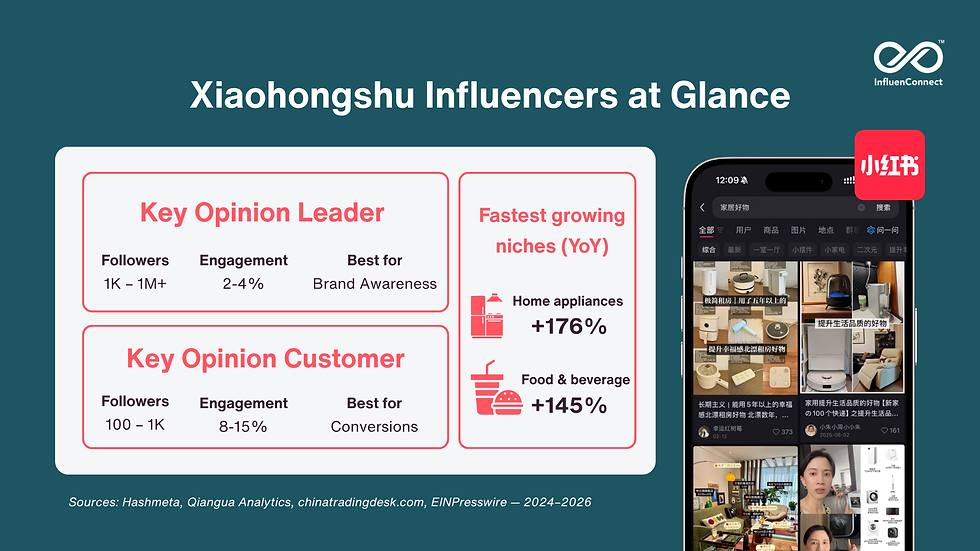
At the same time, Xiaohongshu KOL campaigns have become more segmented. Instead of relying on a few top-tier influencers, brands are increasingly deploying clusters of micro and mid-tier creators to dominate specific keyword niches.
Content Mechanics: What Actually Converts Now
In earlier stages of RedNote marketing, aesthetic visuals and aspirational storytelling were sufficient. In 2026, conversion is driven by three content mechanics:
1. Search-Optimized Narratives
Content must align with how users search. This includes:
Problem-solution framing
Comparison formats
“Honest review” positioning
This shift forces brands to rethink their Little Red Book brand strategy, especially in how briefs are structured for creators.
2. Credibility Over Production Value
Highly polished ads often underperform compared to authentic user-style posts. This is why Xiaohongshu KOL campaigns increasingly prioritize relatability and perceived honesty over visual perfection.
3. Comment Section as Conversion Layer
User interaction in comments often determines final purchase decisions. Brands must actively manage this layer, either through creators or official accounts.
KOL Selection Strategy: Precision Over Scale
Effective Xiaohongshu influencer marketing now depends on precise creator matching rather than broad reach.
Using tools like Influencer Profile, brands can evaluate:
Audience demographics
Engagement authenticity
Content relevance to niche queries
Micro KOLs, typically with 5K to 50K followers, are proving particularly effective in Xiaohongshu KOL campaigns due to higher trust levels and stronger engagement ratios.
Paid and Organic Integration: A Hybrid Model
The separation between paid ads and influencer content is increasingly blurred. High-performing RedNote marketing strategies now follow a hybrid structure:
Seed content through KOLs
Identify top-performing posts
Amplify via paid promotion
This approach aligns with platform algorithms, which favor content that already demonstrates organic engagement.
Managing this at scale requires visibility into ongoing performance, which is where tools like Live Campaigns become critical.
Cross-Platform Amplification Still Matters
While Xiaohongshu is central, it does not operate in isolation. A mature Little Red Book brand strategy includes cross-platform reinforcement.
For example, Weibo Influencer Marketing remains relevant for:
Driving initial awareness
Supporting trending topics
Amplifying campaign reach
This multi-channel approach strengthens overall Xiaohongshu influencer marketing performance by creating repeated exposure across user touchpoints.
Measurement: What Brands Should Track in 2026
Traditional metrics like impressions and likes are insufficient. Modern Xiaohongshu KOL campaigns require deeper performance tracking:
Search ranking for targeted keywords
Save and share rates
Comment sentiment and depth
Conversion proxies such as click-through to e-commerce
This reinforces the importance of optimizing for high-intent engagement rather than broad exposure.
Strategic Implications for Brands
To remain competitive, brands need to recalibrate their RedNote marketing approach along three dimensions:
Content must align with search intent
Creator selection must be data-driven
Paid and organic strategies must be integrated
A fragmented approach will underperform in the current ecosystem.
Conclusion
Xiaohongshu influencer marketing in 2026 is defined by intent, credibility, and system-level integration. The platform rewards brands that understand how users search, how creators build trust, and how content circulates beyond initial publication.
For companies entering or scaling in China, refining their Little Red Book brand strategy is not simply a marketing decision. It is a structural requirement for competing in a discovery-first digital environment.
The brands that succeed will be those that treat Xiaohongshu KOL campaigns not as isolated executions, but as interconnected systems of content, data, and influence.
Ready to Take the Next Step?
At InfluenConnect™, we are paving the way for the next generation of influencers by breaking down language barriers, making it easier for you to collaborate globally. InfluenConnect™ focuses on diversity, global reach, data-driven insights, and sustainability. Contact us today to explore how we can help you expand your global presence!


Comments