


.png)
Why Influencer Pricing Still Feels Like Guesswork Across Markets

Influencer pricing has been treated as a negotiation game for too long. But the strongest brands are not simply trying to secure the cheapest creator rate. They are trying to understand what a fair rate looks like for a particular creator, campaign and market.
That distinction matters. Influencer pricing is not just a cost issue; it is a buying intelligence problem. Without reliable benchmarks and enough context, brands risk overpaying for reach that does not deliver, underpaying creators who genuinely understand their communities, misreading creator value and making unfair cross-market comparisons.
The commercial importance is growing. According to the IAB 2025 Creator Economy Ad Spend & Strategy Report, US creator advertising spend was projected to reach $37 billion in 2025, up 26% year on year, while 48% of creator ad buyers consider creators a “must buy.” As creator investment becomes a larger part of the media mix, pricing becomes increasingly important to how brands allocate, negotiate and protect budgets.
1. The real problem is not that creators charge differently
There is no universal influencer price. Rates naturally vary according to the conditions of the partnership and the market.
Key variables include market conditions, platform and content format, audience quality, production requirements, usage rights, category and seasonality, and creator reputation.
These differences are normal. The problem is the lack of context behind the number.
A rate card tells a brand what a creator charges, but not necessarily whether the rate is typical for that market, justified by the audience, comparable with similar creators or correctly structured around deliverables and usage rights.
Creator type matters too. A KOL, KOC and KOS can bring different forms of commercial value even with similar audience sizes. KOL, KOC and KOS: What Brands Need to Know Before Choosing Creators in Asia provides further context on these differences.
Influencer pricing should therefore be treated as a data and buying intelligence problem, not simply a negotiation problem.
Why follower count is the wrong starting point: The InfluenConnect PRICE™ Framework
Creator price isn’t determined by one metric. It reflects multiple dimensions of commercial value and market context.
The InfluenConnect PRICE™ Framework provides a simple way to think about the factors behind creator pricing:
P — Platform & Production Platform, content format, production effort and deliverables.
R — Reach Quality Audience relevance, authenticity, geography and quality — not just follower count.
I — Influence & Intent Engagement, authority, category relevance, community trust and ability to drive action.
C — Commercial Scope Usage rights, paid amplification, exclusivity, duration, territory and other commercial terms.
E — Economic & Market Context Local creator-market conditions, demand, category competition and market pricing norms.
The framework is not a universal pricing formula. It is a lens for understanding whether a proposed rate makes sense in the context of the creator, campaign and market.
2. Why cross-market pricing gets distorted
Cross-market campaigns make the lack of pricing context even more visible.
A creator in London, Dubai, Singapore, Jakarta or Seoul may charge very different rates from a creator with a similar follower count elsewhere. That does not automatically mean one is expensive or the other offers better value.
Local creator economies operate under different conditions. Audience behaviour, platform penetration, advertiser demand, category maturity, production expectations, creator supply and cultural relevance can all influence pricing.
This makes simple global comparisons unreliable.
Currency conversion can create a false sense of precision. Converting GBP, AED, SGD, IDR or KRW into a common currency makes rates easier to compare numerically, but it does not show where a fee sits within its local creator market.
Currency conversion is financial translation, not price intelligence.
True pricing intelligence requires market-specific benchmarks that help brands understand whether a proposed rate is broadly consistent with comparable creators and campaign requirements in that market.
This is the Economic & Market Context behind the price — and it is one reason a global pricing assumption can quickly become misleading.
Without this context, applying one pricing assumption across markets can make a creator appear artificially expensive in one country and artificially cheap in another.
3. Overpayment is rarely obvious at shortlist stage
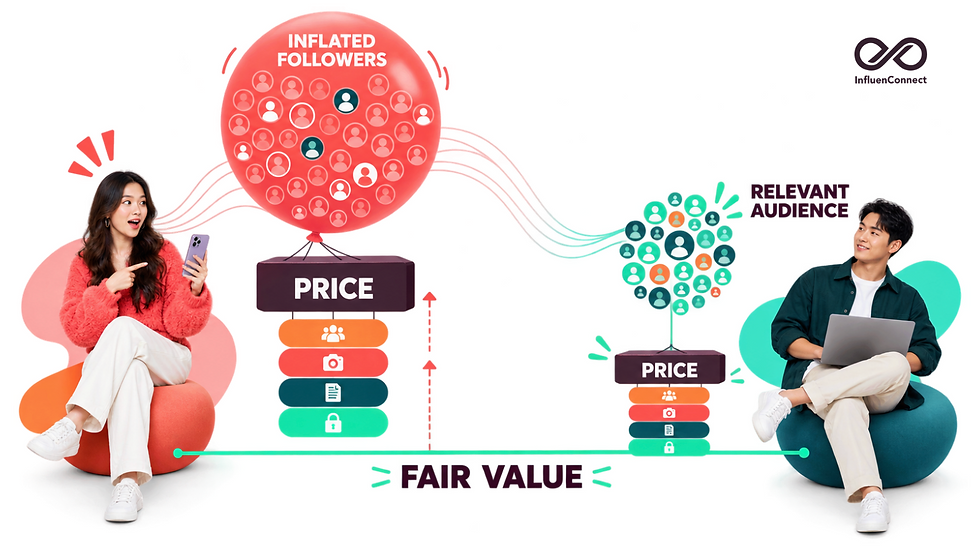
Overpayment often happens because brands have limited information when building their shortlist.
Inflated follower counts can create an immediate perception of value, but audience size alone does not establish commercial relevance. A large following may include inactive, irrelevant or low-quality audiences, while a smaller creator may have a highly concentrated and valuable community.
This is why reach needs to be evaluated in context. Audience relevance, authenticity, geography and quality can matter as much as the size of the audience itself.
The same applies to engagement. Vague engagement claims do not show how performance compares with similar creators, whether it is consistent or whether it comes from the target audience. Brands can use the Engagement Rate Calculator Guide as an evaluation signal rather than treating follower count as a proxy for value.
The measurement challenge is significant. According to EMARKETER’s Influencer Marketing Measurement 2025 report, 32% of marketers worldwide identified measuring creator performance as a roadblock to successful influencer programmes.
Engagement is only one signal of influence. Authority, category relevance and community trust can also indicate whether a creator has the ability to move an audience towards action.
Pricing can be equally difficult to compare. Inconsistent rate cards, agency mark-ups, different deliverables, production requirements, usage rights, exclusivity and additional content can make two seemingly similar offers represent very different commercial value.
Two creator offers can look comparable while representing different total costs because of:
Agency or management mark-ups
Different content deliverables
Production requirements
Usage and licensing rights
Exclusivity
Revision requirements
Additional platforms or content formats
Speed can make the problem worse. When deadlines are tight, panic buying can push brands to secure available creators before validating pricing or comparing alternatives.
Pricing intelligence is therefore most valuable before budget is committed, when brands can still compare creators, challenge inconsistent quotes and adjust the shortlist.
4. Underpayment also damages campaign quality
Pricing transparency should not become another way to push creator fees down.
A benchmark can identify an unusually high rate, but it can also reveal when an offer is unrealistically low. Creators who feel undervalued may be less motivated to invest in the relationship, collaborate closely or prioritise the campaign. Repeatedly offering unrealistic rates can also damage a brand’s reputation among creator communities.
Creator value extends beyond reach. Expertise, cultural understanding, credibility and community trust can all have commercial value.
These qualities are part of the broader influence and intent behind creator value, and they help explain why a fair rate cannot always be inferred from audience size alone.
The IAB 2025 Creator Economy Ad Spend & Strategy Report also highlights creator selection, measurement, standards and operational tools as important considerations as the creator economy matures.
Fair pricing works both ways. Brands need protection from inefficient deals, while creators need a credible basis for demonstrating their value.
The goal is not to force rates down. It is to establish fair commercial value.
5. What smarter creator buying looks like
Smarter creator buying connects pricing with the context behind creator value.
Brands should be able to assess:
Price benchmarks for comparable creators and campaigns
Creator comparisons rather than isolated rate cards
Predicted rate ranges to identify unusual quotes
Performance context alongside pricing
Audience quality including authenticity, relevance and location
Usage-rights clarity to understand the true scope of the deal
Local market conditions that can influence creator pricing
This does not remove negotiation. It makes negotiation more informed.
A smaller creator may be better value because their audience is highly relevant. A larger creator may command a higher fee but deliver weaker value if the audience is poorly aligned. A competitive-looking rate may also become expensive once licensing or exclusivity is added.
The PRICE™ Framework brings these considerations together so brands can evaluate the number alongside the context behind it.
The objective is to understand these variables before the buying decision.
AI can make this process more scalable by analysing creator data, comparing profiles and identifying pricing patterns. AI in Influencer Marketing: Why the Real Shift Is Human-First explores how AI can support creator discovery and evaluation while keeping human judgement at the centre.
6. How InfluenConnect supports pricing intelligence
For brands managing creators across multiple markets, platforms and languages, collecting and comparing this information manually can quickly become difficult to scale.
InfluenConnect helps brands discover, compare, price, vet and manage creators across markets, platforms and languages.
This is where InfluenConnect’s AI Price Intelligence becomes the commercial value layer. Instead of treating pricing as the final negotiation step, brands can bring pricing intelligence into creator selection from the beginning.
AI-powered pricing intelligence can help brands benchmark rates, compare creator opportunities, assess expected rate ranges and understand pricing within the relevant market and campaign context.
This is particularly valuable for cross-market campaigns, where applying the same pricing assumptions across countries can quickly lead to inconsistent decisions.
The value is not simply finding cheaper creators. It is knowing what you are buying before you commit the budget. Pricing can become part of creator selection from the beginning rather than a final-stage negotiation after the shortlist has already been built.
7. Better pricing visibility leads to better buying decisions
Influencer pricing will never be completely uniform, and it should not be. Different markets, creators, audiences, platforms and campaign requirements create legitimate differences in commercial value. The opportunity is to make those differences easier to understand.
The InfluenConnect PRICE™ Framework reinforces a simple principle: creator price is not determined by one metric. It reflects multiple dimensions of commercial value and market context.
Brands need more than rate cards and currency conversions. They need market context, comparable data and a reliable way to assess creator pricing before committing spend. The right benchmark should help brands understand not only what a creator charges, but how that rate compares with the market and the value being offered.
This broader view of creator value also reinforces the importance of evaluating creators beyond surface-level metrics. InfluenConnect’s guides on building authentic influencer partnerships and spotting fake Instagram followers provide further context on assessing creator fit and audience quality.
This is why benchmarking should not be about creating one universal influencer price. It should give brands a clearer basis for understanding whether a rate makes sense for the creator, market and campaign requirements.
Better pricing visibility helps brands:
Protect campaign budgets from inefficient deals
Compare creators more consistently across markets
Identify rates that need further validation
Negotiate from a stronger evidence base
Build fairer creator relationships
Scale creator investment with greater confidence
For creators, greater transparency makes it easier to demonstrate the value behind their rates. For brands, it creates a stronger basis for responsible spending and cross-market growth.
Influencer pricing does not need to become uniform. It needs to become more understandable.
Better data creates better buying decisions. Better buying decisions create more efficient creator investment.


Comments