


Creator-Led Commerce in Vietnam: How to Brief, Price and Vet KOS-Style Sellers
Updated: Oct 17

Creator-led commerce asks creators to do more than attract attention. They may need to explain a product, demonstrate how it works, answer questions and guide audiences towards a measurable commercial action.
Some marketers describe creators performing this role as Key Opinion Sellers, or KOS. But the label alone does not tell a brand whether someone is commercially suitable.
For brand and in-house creator teams planning Vietnam creator commerce campaigns, the more useful questions are:
What is the creator expected to do?
What evidence shows that they can perform that role?
What does the proposed price include?
How will the brand control product claims and promotional information?
Which action will determine whether the activation was useful?
Answering these questions before selecting creators can reduce uncertainty around suitability, pricing, trust and accountability.
1. A KOS is a commercial role, not just another creator label
For this article, KOS means Key Opinion Seller: a commerce-focused creator whose assigned role may include:
Demonstrating a product
Explaining its features or category
Interacting with prospective customers
Responding to purchase questions or objections
Supporting an affiliate, lead-generation or sales-oriented action
Terminology varies between markets and organisations. KOS should therefore be treated as a working description of a commercial role—not a universal creator category, a Vietnamese legal classification or a guarantee of sales.
A KOL may contribute category authority. A KOC may provide relatable product experience. A KOS-style seller works closer to a commercial action. The same creator could perform different roles across different campaigns.
For a broader explanation, see InfluenConnect’s guide to KOL, KOC and KOS creator strategy.
2. The operating context for creator-led commerce in Vietnam
Vietnam’s Law on E-commerce and implementing Decree No. 248/2026/ND-CP took effect on 1 July 2026.
According to Vietnam’s Ministry of Industry and Trade, the framework addresses livestream selling and affiliate marketing alongside wider responsibilities across the e-commerce ecosystem. Its guidance states that product presentations must be truthful and must not mislead consumers about product functions, quality, origin, pricing, warranty policies or availability.
For affiliate marketing, the guidance also addresses transparency around affiliate links, referral codes and the responsibilities of participating parties.
The Ministry subsequently emphasised the need for businesses to incorporate compliance into their operations, from providing information and managing sales activity to receiving and resolving customer feedback and complaints.
For brands planning creator-led commerce, this makes role definition and operating controls important parts of the brief. However, the exact obligations will depend on the creator’s role, commercial arrangement and sales activity. Brands should not assume that every provision applies identically to every creator partnership.
3. Start with the selling role, not the KOS label
Before searching for a KOS-style seller, the brand should define the action the creator is expected to support.
That action might involve:
Introducing an unfamiliar product
Demonstrating how the product works
Explaining differences between products
Responding to customer questions
Addressing common purchase objections
Directing users to a retailer, lead form or commerce destination
Supporting a livestream or promotional event
Generating attributable affiliate activity
These responsibilities require different skills.
A creator who produces clear product demonstrations may not be comfortable managing an extended live conversation. A confident livestream host may create urgency but may not suit a premium brand that requires a more considered tone. A creator with strong category knowledge may be credible for education but may not reach the intended buyers.
The brief should therefore define the required commercial action before the team evaluates creators.
A clear role statement might be:
The creator’s role is to demonstrate the product, answer agreed customer questions and direct relevant viewers to the approved commerce destination.
This provides a stronger basis for livestream creator selection than simply asking for a “Vietnam KOS”.
4. KOS pricing is an operating model, not a single creator fee
The headline creator fee rarely represents the complete cost of a creator-led commerce activation.
Depending on the brief, the commercial arrangement may include:
A fixed content or appearance fee
Affiliate commission
A sales-based incentive
A hybrid fee-and-commission structure
Livestream preparation and duration
Content production and revisions
Product samples
Usage and paid-amplification rights
Category exclusivity
Platform or agency fees
Promotional discounts or vouchers
Brands should establish what each payment covers before deciding whether the proposal represents appropriate value.
For example, a lower fixed fee may be accompanied by a higher commission, additional production costs or extensive promotional support. A higher quotation may already include revisions and usage rights that another creator has priced separately. The headline fees alone would not provide a fair basis for evaluation.
Attribution also needs to be agreed in advance:
What counts as an attributable action?
Which link, code or destination will be used?
How long will the attribution window remain open?
How will cancellations and returns be treated?
Who will provide the reporting?
When will commissions become payable?
Pricing should be assessed alongside the creator’s role, audience relevance, production requirements, commercial rights and level of brand risk.
InfluenConnect’s guide to influencer pricing across markets explains why follower count and a headline rate provide an incomplete basis for creator-buying decisions.
5. Seller-led influence creates additional trust risks
When creators move closer to conversion, inaccurate information can affect customer expectations, purchasing decisions and confidence in the brand.
Before approving a creator, brands should review:
Whether the creator understands the product and category
Whether the audience is relevant to the intended buyer
Whether demonstrations represent the product accurately
Whether product claims have been reviewed and approved
Whether sponsorship or commission arrangements will be disclosed appropriately
Whether previous partnerships create a potential conflict
Whether the creator’s communication and selling style fit the brand
Whether engagement or performance claims require further validation
Visible activity should not be treated as automatic proof of commercial suitability. A busy livestream, large following or claimed sales result does not by itself establish audience quality, accurate attribution or likely future performance.
Vietnam’s current e-commerce framework specifically addresses truthful product presentation, livestream selling, affiliate transparency and the responsibilities of participating parties. The responsibilities relevant to a campaign should be checked against its actual structure rather than applied indiscriminately to every creator arrangement.
Brands should also provide approved product information and escalation procedures before activity begins. This is especially important during livestreams, where questions and inaccurate claims can develop before the brand has time to intervene.
For a broader authenticity review, see InfluenConnect’s guide to spotting fake or unreliable influence before it affects campaign budget.
6. Five checks for briefing a KOS-style seller
A practical KOS-style brief should connect five decisions.
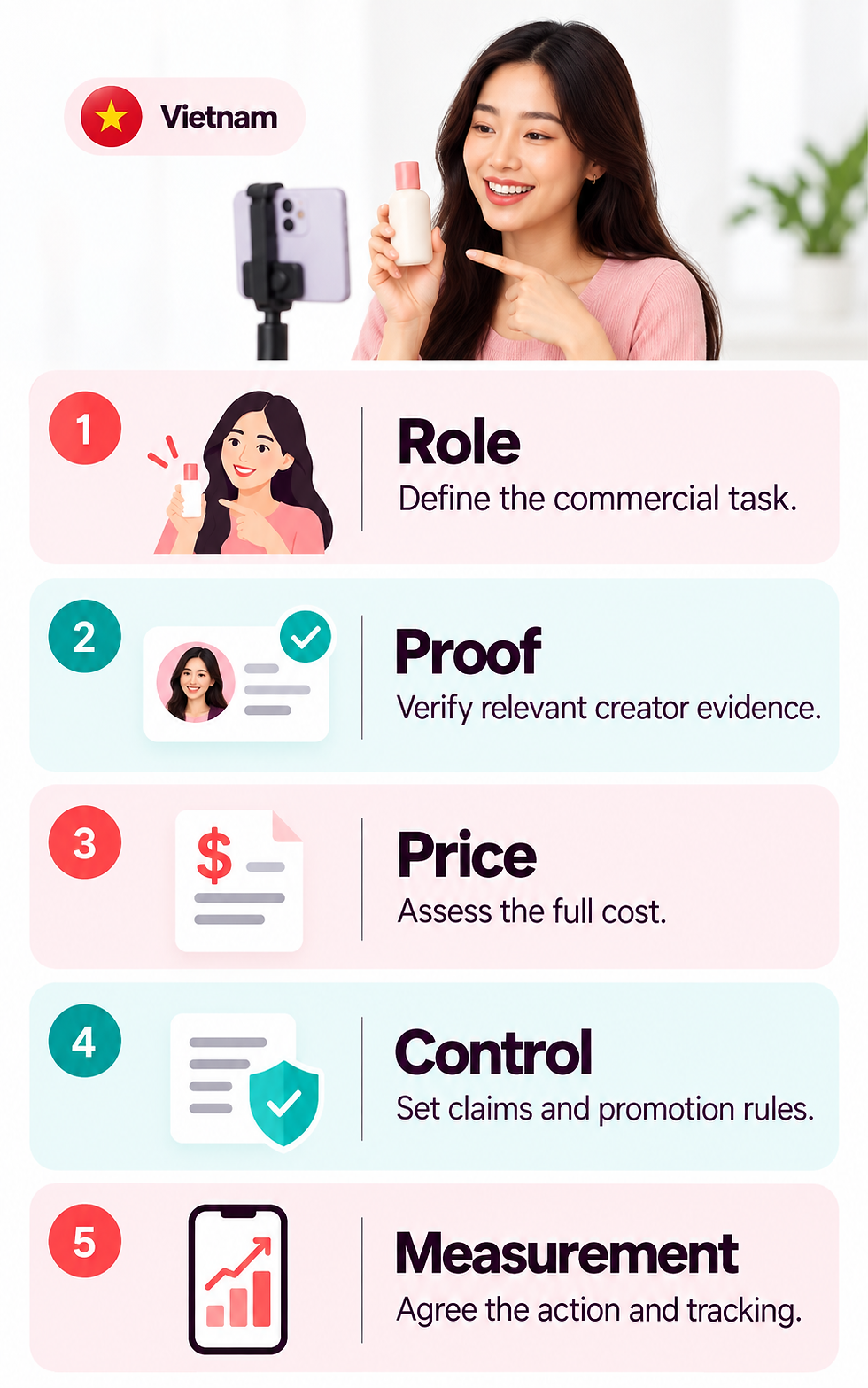
Role
What commercial action is the creator expected to support?
Specify whether the role involves education, demonstration, objection handling, lead generation, livestream interaction, affiliate activity or another defined action.
Proof
What evidence suggests that the creator can perform that role?
Review relevant content history, category credibility, audience fit, communication style and available performance evidence. One viral post or an unverified sales claim should not be treated as sufficient proof.
Price
Does the commercial structure reflect the work, audience, rights and risk involved?
Assess the fixed fee, commission, preparation time, production requirements, usage rights, exclusivity and additional costs together.
Control
How will the brand manage product claims, discounts and customer expectations?
Set clear boundaries covering approved messages, prohibited claims, promotional pricing, stock information, content approval and escalation. For livestream activity, establish who is authorised to respond when an unexpected question arises.
Measurement
Which action will determine whether the activation was useful?
Possible measures include qualified visits, attributed orders, approved leads, code usage or another campaign-specific action. The brand should agree on the measurement route before activation rather than attempt to reconstruct it afterwards.
Illustrative example
A beauty brand planning a product demonstration could apply the framework as follows:
Role: Define the creator’s role as demonstrating the product and directing interested viewers to an approved product page.
Proof: Review category experience, audience suitability, presentation style and relevant content history.
Price: Separate the creator fee, commission, production requirements and usage rights.
Control: Approve product claims, demonstration instructions and promotional information before publication.
Measurement: Agree on the tracked link, code or other attributable action before the campaign begins.
This is an illustrative planning example. It does not represent an actual campaign or imply a particular commercial result.
7. How InfluenConnect supports better KOS decisions
Creator-led commerce still begins with creator selection.
InfluenConnect supports creator discovery, pricing intelligence and brand-suitability assessment across markets. Teams should confirm available Vietnam profiles and data against their campaign brief.
Depending on the information available, teams can use InfluenConnect to support a more structured process for:
Discovering creators relevant to the market and category
Reviewing available audience, content and performance context
Assessing available pricing information
Examining previous brand partnerships
Vetting authenticity and brand suitability
Building a focused shortlist around the required commercial role
InfluenConnect does not guarantee sales, provide automated legal compliance or replace a brand’s responsibility to review local requirements. Brands should also not assume the availability of a dedicated KOS filter or complete Vietnam-specific data for every brief.
InfluenConnect’s role is to give teams a clearer basis for creator selection before budget is committed.
Build a Vietnam-ready creator shortlist
A KOS-style seller should not be selected from the label alone.
Brands need to align five elements:
The commercial role
Evidence of creator suitability
The complete pricing structure
The necessary operating controls
The agreed measurement route
The central question is not simply:
Who is a KOS in Vietnam?
It is:
Which creator can perform the required commercial role credibly, at an appropriate price and within the controls the brand needs?



Comments